
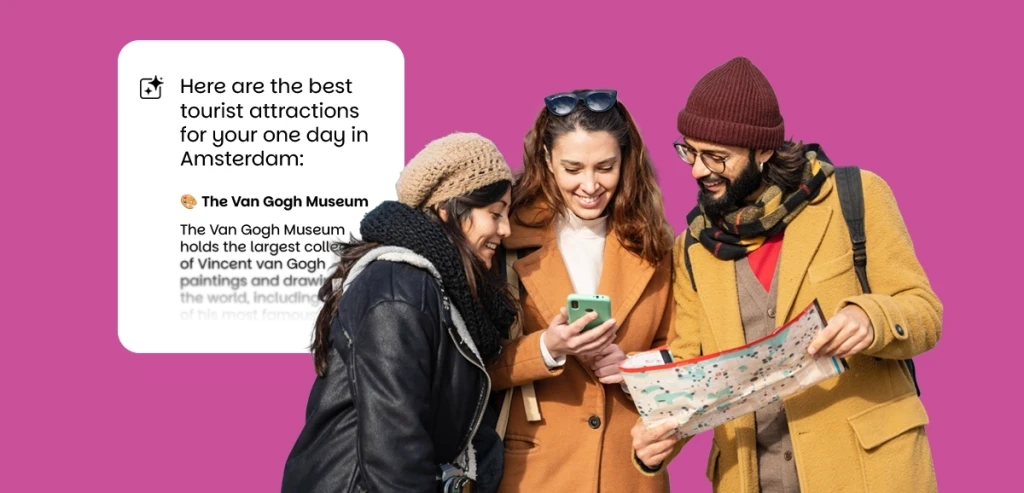
Not so long ago, the customer journey for sightseeing and attractions was simple. Someone searched, clicked your website, browsed a few pages, and booked.
That model is quietly breaking. Today, many travellers never reach your homepage. Google’s AI Overviews answer questions before anyone clicks. Maps show opening hours, reviews, and photos. TikTok suggests things to do. ChatGPT drafts itineraries. By the time a decision is made, people may only have encountered your brand as a pin on a map, a short AI summary, and a handful of visitor images.
For attractions and sightseeing brands, this is no longer theoretical. Website traffic can fall even when rankings stay steady. Practical content appears directly in search results, giving users the basics without visiting your site. In some cases, organic sessions are down double digits year on year, while bookings remain stable or even grow. At first glance, this feels worrying. Look closer, and a different picture emerges. Discovery hasn’t disappeared; it has simply moved.
Discovery now takes place across social and AI
Discovery increasingly starts on social rather than search. For many travellers – especially Gen Z – TikTok isn’t just for inspiration. People watch short clips, save ideas, and plan entire holidays without consulting a search engine, let alone a traditional guidebook. Instagram works similarly, with saved posts acting as travel bookmarks. They follow creators whose taste they trust instead of relying on brands.
This changes how creative works. Ads and social content are often the first touchpoint, not the last. They need to show the experience quickly, make the location obvious, signal who it’s for, and answer questions before they’re asked. Paid media plays a crucial role here. Upper-funnel video and paid social often drive more branded search and better Performance Max results downstream than any tweak to keywords ever could. Even simple creative refreshes consistently improve efficiency.
Automation has levelled the media buying field. Broad Match, Performance Max, and AI Max mean most brands now have access to similar tools. Creative is what sets a brand apart. The attractions that do best treat it as an ongoing process, not a one-off campaign. They test regularly, adjust content for each market, and use local insight to make sure their message works both culturally and commercially.
Make your content clear enough for AI and humans
AI tools and chat assistants are changing how attractions get noticed. People aren’t just typing keywords – they’re asking for itineraries, recommendations, or ‘what’s worth seeing this weekend.’ That means content has to be clear enough for these tools to understand, without losing the details that help someone decide to visit.
Families planning a trip to London might rely on ChatGPT to pull together a day out. The AI doesn’t care about clever copy or brand storytelling. It needs the essentials: what the attraction is, how long it takes, who it suits, where it is, and what makes it different. Meanwhile, a couple already in Barcelona might scroll TikTok for ideas, then check Maps for opening hours and reviews. Details need to be consistent across platforms.
The attractions that come out on top keep these basics tidy. Photos are up to date, opening times are correct, structured information is easy to parse, and descriptions are consistent from the website to Maps and social feeds. They pair that with richer storytelling where it matters. The goal is to make sure your brand is understood quickly and reliably. SEO, UX, and content marketing all play a role in keeping these touchpoints accurate and useful.
Treat Google Business Profiles as a performance channel
Once you’ve accepted that discovery happens everywhere, your Google Business Profile becomes one of the most important touchpoints. For many attractions – especially in-city visitors – it can do more selling than the homepage ever could: opening hours, location, photos, reviews, busy times, accessibility details, ticket information.
Yet it’s not uncommon to see profiles that fall behind:
- Seasonal hours never updated
- Old ticket prices lingering in Q&A sections
- Missing attributes like accessibility or family friendliness
- Descriptions written years ago and forgotten
- Photo galleries that no longer reflect the current experience
Usually, this isn’t neglect. More often, it’s organisational drift. The person responsible has moved on, sometimes taking log-ins and knowledge with them. Marketing assumes operations has it covered, operations assumes head office is managing it, and head office assumes the local team is on top of it. In reality, no one is.
The strongest attractions treat their profiles like a living part of the business. Photos are refreshed regularly. Questions are answered before visitors even think to ask them. Descriptions are localised for each market. Opening hours change as soon as seasons shift. Reviews are responded to in a way that sounds human.
We’ve seen sightseeing operators in major cities achieve meaningful uplifts simply by keeping these basics in order – not through clever tricks, but through steady, unglamorous attention. You can read our tips on optimising Google Business Profiles here.
Re-design your website for decision-making, not discovery
None of this means that your website is irrelevant. It still drives conversions, builds trust, shares practical information, and supports more complex planning. The difference is that it’s no longer the starting point for most journeys.
For most visitors, the site is more like a confirmation step. They’ve already seen reviews, compared options, and know roughly what they want. Sites should focus on making decisions easy: clear pricing, simple logistics, and straightforward next steps. The best operators treat their websites less like brochures and more like booking assistants. They remove friction, anticipate questions, and guide visitors smoothly to a decision. Even a homepage with fewer clicks can still drive strong results.
Think ecosystem, not homepage
The biggest mindset shift is this: attractions can’t focus solely on driving traffic to a website. They need to be present across an ecosystem:
- Accurate information everywhere
- Creative designed for discovery as well as conversion
- Content structured for AI and human readers
- Paid media shaped by intent and location
- Local insight guiding global strategy
Local expertise matters. People in different markets notice different details, respond to different messages, and value different experiences. What works in Paris might not land in Tokyo. How Germans research attractions differs from Americans. Even small cultural or practical differences can decide whether a visit feels worthwhile.
Be useful across every touchpoint
Now, marketing is less about neat funnels and more about surfaces. You aren’t guiding people carefully from search to site to sale. You are showing up in dozens of small moments: a map result, an AI paragraph, a social video, a review snippet, a chatbot recommendation. Winning means being consistently useful, accurate, and compelling in all of them.
A modern growth strategy for sightseeing and attractions includes:
- Structuring content so AI can understand your offer
- Treating Google Business Profiles as core performance assets
- Investing in ongoing creative refresh, not sporadic campaigns
- Segmenting audiences by location and intent
- Designing websites for decision-making, not discovery
- Using local insight from on-the-ground experts to inform global execution
Ignore these changes, and your brand risks being overlooked where decisions are actually made. Embrace them, and you give yourself a real chance to succeed in a more fragmented, competitive landscape.
Adapt and stay visible in 2026
At Oban, we help attractions grow internationally by adapting to this new reality. We combine SEO, paid media, and UX with insight from our Local In-Market Experts to make sure your brand shows up clearly in every key market. If traffic is falling but bookings hold steady, if Google Business Profiles are slipping, or if you’re unsure how AI-driven discovery fits into your plans, let’s talk.
Let’s accelerate action together
At Oban, we believe change happens when we act, support each other, and keep moving forward. These stories show how small steps can make a big difference. If you want to improve your digital marketing, get in touch. Let’s get started.