
For years, international e-commerce was largely built around localisation at the website level. Businesses adapted their sites for different markets, displayed local currencies, created country-specific experiences and used search to reach new customers.
That approach reflected how search worked at the time. When search engines primarily matched keywords with pages, accurate translations and strong international SEO were often enough to build visibility in new markets.
Today, search works differently. Search engines and AI-powered search tools are more focused on understanding meaning, intent and context. They interpret what people are looking for, identify the products that best meet those needs and assess whether a brand is relevant within a particular market.
This creates a challenge for international retailers. Accurate translation remains important, but products also need to be understood consistently by customers, search engines and AI systems in every market. The gap between how a brand describes its products, how customers search for them and how AI systems interpret those signals can be thought of as the semantic gap.
What is the semantic gap in multilingual e-commerce?
The semantic gap is the distance between the language brands use to describe their products, the language customers naturally use when searching and the way search engines and AI systems connect those signals.
When that gap widens, products become harder to discover, understand and recommend in international search. This explains why literal keyword translation often falls short. Even an accurate translation can miss the terminology, expectations and context that local audiences associate with a product category. A successful multilingual e-commerce strategy is therefore built around closing the semantic gap.
Language has never been a simple code that can be converted from one market to another. Words carry cultural meaning, reflecting buying habits, product expectations, regional terminology and the way people describe what they need.
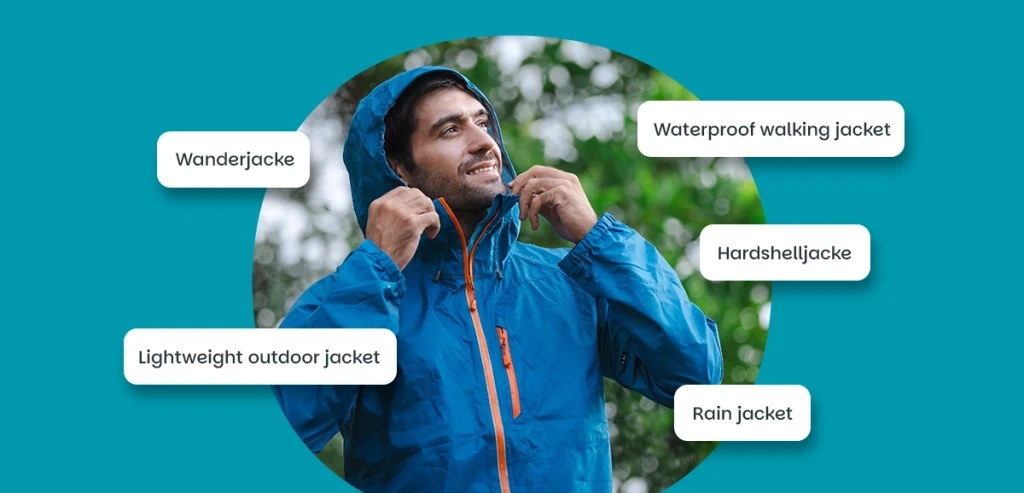
Consider outdoor clothing. A customer in the UK searching for a waterproof jacket is often thinking about walking in changeable weather. In Germany, customers may search for a Hardshelljacke that emphasises technical performance, while Japanese retailers often position similar products around lightweight outdoor use. Although the garment itself may be almost identical, the language, expectations and category associations differ considerably.
| Market | Common search behaviour |
| United Kingdom | Waterproof walking jacket |
| United States | Rain jacket |
| Germany | Hardshelljacke or Wanderjacke |
| Japan | Lightweight outdoor jacket |
Customers search differently, retailers organise categories differently and competitors emphasise different benefits across markets. These differences influence how search engines and AI systems understand relevance.
AI-powered search is increasingly focused on building confidence around questions such as:
- What is the product?
- Who is it designed for?
- Which category does it belong to?
- How does it compare with alternatives?
- When is it relevant to recommend?
Closing the semantic gap means helping both people and machines understand products in a way that feels natural within each market.
Why multilingual e-commerce brands struggle with search visibility
Despite significant investment in international expansion, enterprise retailers can still face visibility challenges. Often, the issue lies not in technical SEO, but in localisation strategies that were designed for a different era. Common mistakes include:
Mistake #1: Treating translation as localisation
Organisations can invest heavily in translating product pages, believing they have created a local experience. Translation provides an important foundation, but effective localisation requires a deeper understanding of how customers search, compare and make decisions within each market.
A product description that performs well in English may fail elsewhere because it reflects assumptions from its original market rather than the expectations of local customers. Effective localisation considers:
- Local search behaviour
- Market-specific terminology
- Cultural preferences
- Competitor positioning
- Purchasing motivations
Rather than asking whether a product description has been translated correctly, brands should ask whether it feels as though it was created for customers in that market from the outset. That principle sits at the heart of a multilingual content strategy built around local search behaviour rather than direct translation.
Mistake #2: Optimising keywords instead of meaning
International SEO has traditionally centred on keyword mapping. Research identifies equivalent keywords across markets before assigning them to individual pages. While keyword research remains valuable, semantic search requires a broader perspective.
Search engines increasingly evaluate entities, relationships, context and intent alongside individual search terms. Rather than asking, “Which keyword should we translate?”, international retailers should ask: “How do customers in this market understand and describe this product category?”
Ultimately, products are purchased when they align with a particular need, lifestyle or problem. The closer content reflects that understanding, the easier it becomes for search engines and AI systems to connect products with relevant audiences.
How AI search is changing multilingual e-commerce
Product pages are no longer interpreted in isolation. AI systems increasingly assess products and brands using signals from across the web, including structured product data, customer reviews, trusted publications and wider authority signals.
Rather than viewing products as collections of keywords, search engines and AI systems build an understanding of relationships between products, categories, brands and customer intent. They consider factors such as:
- The brand
- The product
- The category
- The intended audience
- The wider market context
This has important implications for international retailers. Returning to our waterproof jacket example, the way customers understand and search for the same product varies by market.
In the UK, customers may search for a waterproof walking jacket. In Germany, similar products may be positioned as hiking shell jackets. In Japan, the focus may be on lightweight outdoor performance wear designed for changing weather conditions. The product itself has not changed, but the meaning surrounding it has.
Successful localisation requires brands to communicate category relationships, product attributes, intended use and customer expectations in ways that make sense within each market. The clearer these signals are, the easier it becomes for AI systems to understand where a product fits and when it should be recommended.
How Oban helps brands close the semantic gap
Closing the semantic gap requires a structured approach that helps customers, search engines and AI systems develop a consistent understanding of products across every market. At Oban, we think about this through a six-step semantic localisation framework.
1. Understand local search intent before translating
Translation should never be the first step. The starting point is understanding how customers search and what influences their decisions, which means identifying:
- The terminology they naturally use
- The problems they are trying to solve
- The benefits they prioritise
- The language competitors use to position similar products
This research should combine traditional keyword analysis with SERP analysis, marketplace research and insights from local market specialists. For many organisations, one of the biggest opportunities comes from identifying international content gaps through local market research rather than relying solely on translated keyword lists.
2. Adapt product language, not just website language
Every product contains opportunities to strengthen semantic relevance. Localisation should extend across:
- Product titles
- Descriptions
- Specifications
- Categories
- Product attributes
- FAQs
The objective is not identical wording across every market but preserving meaning while allowing language to evolve naturally for local audiences. A strong multilingual product catalogue should feel as though it was created locally rather than translated centrally.
3. Build machine-readable product information
Clear product information helps customers make decisions, while structured information helps search engines and AI systems understand products more effectively. Search engines increasingly rely on structured data and consistent taxonomy to understand relationships between products. Enterprise retailers should prioritise:
- Product schema
- Semantic HTML
- Clear heading structures
- Structured FAQs
- Consistent taxonomy
- Detailed product attributes
These signals help search engines understand what a product is, who it is intended for and how it compares with alternatives.
4. Create consistent brand entities across markets
International expansion can lead to fragmented digital identities. Country websites often evolve independently, product naming conventions can change over time and business information may vary across platforms. These inconsistencies can weaken how search engines and AI systems understand a brand.
Search engines and AI systems need confidence that your UK, German and French operations represent the same organisation. Consistency should extend across:
- Company information
- Product naming
- Locations
- Social media profiles
- External references
- Structured business information
Without this consistency, brands risk entity fragmentation, where AI systems develop weaker or conflicting understandings of the same organisation across markets.
5. Build local authority signals
Your own website is only one source of information. Search engines and AI systems also evaluate how your brand is represented elsewhere. Strong local authority can be developed through:
- Customer reviews
- Partnerships
- Industry publications
- Local backlinks
- Trusted marketplaces
- Regional media coverage
Together, these signals reinforce relevance within individual markets and strengthen confidence in your brand. These activities should sit alongside the wider considerations involved in creating a successful cross-border e-commerce strategy, including customer experience, payments, fulfilment and market selection.
6. Continuously measure and refine
International search is constantly evolving, as customer behaviour changes, competitors reposition their products, search engines introduce new capabilities and AI systems become more sophisticated. As a result, multilingual strategies need ongoing refinement. Brands should continually monitor:
- Visibility across individual markets
- AI mentions, citations and recommendation frequency
- Keyword performance
- Product discovery
- Conversion rates
- Customer behaviour
Each insight helps reduce the semantic gap over time. Those incremental improvements compound into stronger international visibility and better commercial performance.
The future of multilingual e-commerce
As AI search continues to evolve, brands that invest in local language, local intent and local context will be better placed to earn visibility wherever customers discover products. If you’re reviewing your multilingual e-commerce strategy or want to understand how semantic localisation could improve international search performance, Oban can help. Get in touch to discuss your goals.
Let’s accelerate action together
At Oban, we believe change happens when we act, support each other, and keep moving forward. These stories show how small steps can make a big difference. If you want to improve your digital marketing, get in touch. Let’s get started.