

Search journeys no longer follow the same predictable path. With Google’s AI Mode and other generative interfaces, users encounter brands in fragmented, conversational ways: answers are summarised, sources cited, and choices compressed. That means the old yardsticks – keyword rankings, click-through rates, raw traffic – provide a partial and often misleading picture of performance.
The task now is to measure what really matters: whether your brand is visible in these new surfaces, whether that visibility generates demand, and whether demand converts into revenue. In AI Mode, visibility and authority are the core KPIs – influencing consumer decisions and remaining competitive can only happen once these are folded into measurement strategies. Legacy metrics are no longer sufficient and new diagnostic signals are required to measure success.
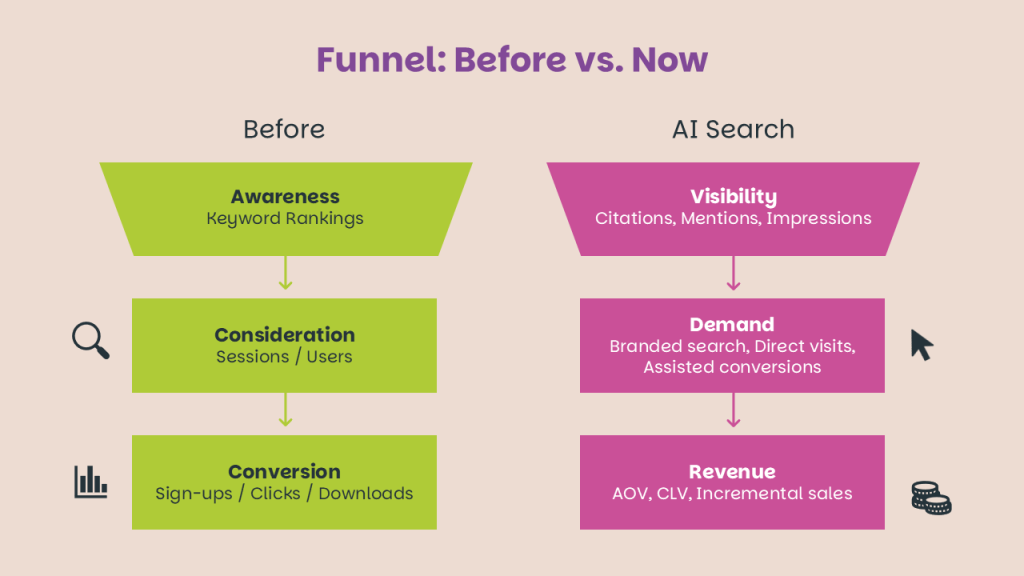
Rethinking the funnel: Before → Now
The familiar funnel hasn’t disappeared, but its signals look different in AI-driven search. Each stage now requires new benchmarks and smarter ways to measure success:
Top of funnel: From rankings to visibility
- Before: Keyword positions were a proxy for awareness. Secure position one, earn the click, grow top-of-funnel reach.
- Now: In AI Mode, there is no rank. There are citations, inclusions, and mentions. Your goal is visibility within AI responses, across formats (text, voice, image).
What to measure:
- Frequency of brand mentions in AI-generated answers
- Impressions of AI results (where tools allow)
- Engagement with multimodal assets (images, videos, audio)
- Share of voice compared with competitors inside AI Mode
Mid-funnel: From raw traffic to demand signals
- Before: Sessions and users were the yardstick. More traffic meant more opportunity.
- Now: Clicks are filtered. AI Mode often answers the question before the user visits your site. The key is whether that exposure translates into demand.
What to measure:
- Growth in branded search volume
- Direct visits (desktop and mobile)
- Changes in conversion rate (CVR) from organic and paid sessions
Bottom of funnel: From micro-actions to revenue
- Before: Reporting often ended at website actions – sign-ups, downloads, button clicks.
- Now: These don’t capture the full picture. AI Mode shortens journeys and reshapes attribution. The benchmark has to be business outcomes.
What to measure:
- Omnichannel revenue (from organic and paid combined)
- Average order value (AOV)
- Customer lifetime value (CLV)
- Incremental brand demand
Practical implications for SEO
These shifts mean SEO reporting has to be rebuilt. Ultimately, it’s about understanding how well your brand shows up in AI environments. To achieve this:
- Track inclusion, not rank. SEO success in AI Mode means being cited as a trusted source. Build reporting frameworks that capture citation frequency, not just traditional impressions.
- Build AI-friendly content. Building brand consensus on other authoritative websites, semantic HTML/structured data, and multimodal assets increases your chances of being surfaced. Make sure you’re not blocking AI crawlers from accessing your site, as this limits your visibility in emerging search experiences. Measurement needs to reflect this broader asset base.
- Reset traffic expectations. Fewer visits do not automatically mean weaker performance but weak citations will – look for stronger conversion signals from smaller but more qualified audiences.
Practical implications for Paid Media
Paid media campaigns face different challenges. As platforms like Google invest and develop these new technologies, they are monetising them through building in new ad placements and further automations. This means you need to:
- Prepare to innovate at pace. Newad formats and targeting tactics are emerging as surfaces evolve, such as AI Max and Performance Max.
- Embrace automation. The new campaign types and ad formats that enable brands to compete offer less control but more powerful tools; these must be onboarded not avoided.
- Experiment with reach. More powerful tools should enable advertisers to venture out into keyword portfolios that may have been previously red-taped by inferior tech delivering lower performance. Now is the time to test these again.
Why international marketers need a different lens
AI Mode adoption doesn’t look the same everywhere. That makes local knowledge essential for building KPI frameworks that actually reflect how people search. For example:
- In some countries, users trust AI answers and act directly.
- In others, they still prefer to click through.
- Voice-first markets reshape how prompts are phrased and how results are consumed.
- Markets with lower trust in AI may demand traditional signals (reviews, brand recognition) before acting.
- Where mobile dominates, AI search blends with app ecosystems, changing what ‘visibility’ means.
- In regions with slower AI rollout, legacy KPIs still matter longer, creating a hybrid measurement challenge.
- Heavily regulated markets may restrict what AI can display, influencing how brands appear (or don’t).
As a result, a single KPI framework won’t always work across borders. Global reporting needs to adapt to local realities, which is why Oban works with our Local In-Market Experts (LIMEs) to understand how people in different markets actually interact with AI Mode. Without that insight, you risk optimising to averages that smooth over crucial differences.
What to do now
It’s time to take stock of your reporting. Here are practical steps to replace legacy metrics with ones that reveal the true impact of AI search:
- Audit your dashboards. Identify where legacy KPIs (rankings, raw traffic, CTR) still dominate.
- Layer in demand and revenue metrics. Branded search, direct visits, AOV, and CLV should become standard, not optional extras.
- Start benchmarking citations. Even if tools are imperfect, begin establishing baselines for how often you appear in AI responses.
- Localise measurement. Build frameworks that flex by market, informed by local expertise.
- Educate stakeholders. Explain that traffic may dip while demand and revenue hold steady or rise. AI Mode changes the relationship between visibility and clicks.
Start with a clear benchmark
Our AI Search Visibility Audit measures your current position across AI search, including brand mentions, competitor visibility, important sources and market differences, then turns the findings into a prioritised action plan.
Final thought
Search has changed. The rise of AI-powered interfaces and shifting user behaviour mean the old ways of tracking performance – keyword positions, clicks, and global averages – are less useful than they once were. What matters now is understanding whether visibility is driving demand, and whether that demand translates into revenue.
At Oban, we help international brands update their measurement frameworks so they match today’s search reality, using insights from local experts to link visibility, demand, and revenue across markets. To find out more, get in touch.
Let’s accelerate action together
At Oban, we believe change happens when we act, support each other, and keep moving forward. These stories show how small steps can make a big difference. If you want to improve your digital marketing, get in touch. Let’s get started.