
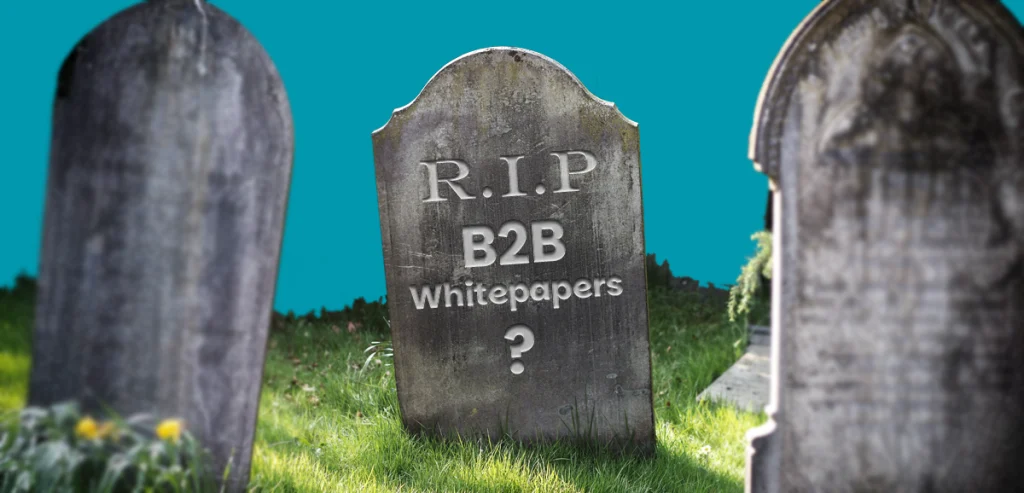
Traditionally, whitepapers have been the heavyweight champions of B2B content: dense, serious, and full of charts that screamed authority. But now AI is rewriting the rules of research, discovery, and decision-making. Ask yourself: do buyers really want another 20-page PDF when generative AI can give them the gist in seconds?
As ever, the answer is nuanced. Whitepapers aren’t dead, but they must evolve. To survive, they need to be smarter and sharper than the AI now competing for your audience’s attention.
The digital marketing reset: AI Mode and beyond
AI is changing how people find and consume information. Google’s AI Mode, powered by Gemini 2.5 Pro, creates conversational, assistant-style search results. It pulls from trusted sources, summarises them, and gives users quick answers, often in a dialogue. That has big implications for the role of long-form content.
Why read a static whitepaper when AI can boil it down in seconds? For overstretched decision-makers, this is appealing. Add shifting buyer demographics (with Millennials and Gen Z well represented in procurement roles) and their preference for visual, interactive formats, and the classic whitepaper begins to look like a relic. But that’s not the whole story.
The case for whitepapers
Despite the hype around short-form content, many B2B buyers still need depth. In complex sectors like finance, cybersecurity, and life sciences, decisions involve risk, multiple stakeholders, and detailed information. A solid whitepaper can still:
- Educate better than most formats: AI can summarise, but it can’t always explain the ‘why’ behind the trend. Whitepapers provide context and frameworks.
- Build trust and authority: A thoughtful paper signals seriousness and shows that your company isn’t just chasing clicks.
- Fuel lead generation: Gated downloads remain a proven way to capture high-intent leads. According to the Content Marketing Institute, 51% of B2B marketers consider thought leadership e-books or white papers to deliver some of their best results.
- Offer durability: Unlike a social media post or fleeting video clip, a strong whitepaper can be referenced months or years later.
In short: the medium isn’t dead, but lazy whitepapers are.
The case against whitepapers
That said, the headwinds are real. They include:
- Information overload: The average B2B buyer is drowning in content. Most, if not all, of your competitors have published a whitepaper on roughly the same topics. Many are templated, bland, and indistinguishable from each other. Standing out isn’t about adding volume – it’s about delivering genuinely original, first-hand insights.
- Static experience: We live in a world where people expect interaction – swipeable carousels, clickable dashboards, short-form videos with movement and energy. Against that backdrop, a static PDF download can feel like a relic from a bygone era. Unless the content is exceptional, whitepapers risk being filed away unread.
- Time-poor audiences: Decision-makers don’t have long stretches of time to wade through 5,000 words. They dip in and out, skim, and move on quickly. A heavyweight whitepaper can feel like a hard sell when attention spans are shorter and expectations for efficiency are higher.
- AI shortcuts: Perhaps the toughest challenge of all. If a generative AI tool can take your whitepaper, strip out the nuance, and present a neat summary in seconds, you have to ask: what value did the original add? The uncomfortable truth is that many whitepapers don’t go beyond what AI could auto-generate. That’s a credibility problem as much as an engagement one. (The Content Marketing Institute found that only 4% of B2B marketers report a high level of trust in generative AI’s outputs, and only 17% rate AI-generated content as excellent or very good.)
These criticisms don’t make whitepapers irrelevant, but they do raise the bar. In today’s market, the only whitepapers worth writing are those that go further: offering original insights, first-party data, or sharp opinions that AI can’t easily replicate.
How to adapt whitepapers for an AI world
If you are creating B2B whitepapers in 2025, here are five ways to make sure they cut through:
#1: Offer what AI can’t
Anyone can churn out generic insights with ChatGPT or Gemini. What AI can’t do is access your proprietary data, your client results, or your lived experience. Whitepapers that lead with first-party research, interviews with industry specialists, or contrarian takes will stand apart because they contain something genuinely new. That’s the difference between being summarised by AI and being quoted by it.
#2: Think modular
A 20-page PDF sitting behind a form isn’t enough. Break your paper into sections that can live independently as blog posts, LinkedIn carousels, or even short video explainers. Sometimes audiences want the deep dive; other times, a concise takeaway will do. By designing your paper as a cluster of reusable assets, you extend its reach and make it work harder.
#3: Think international
A ‘global’ whitepaper that’s just been translated word-for-word is rarely convincing. What works in the UK may fall flat in Japan or Germany. Regulations differ, tone differs, humour differs. This is where local experts (like Oban’s LIMEs) matter: they know which examples land, which stats carry weight, and which angles to avoid. In an AI-driven world, where content is everywhere, this kind of local nuance is what makes yours credible.
#4: Pair with other formats
Don’t publish and hope someone downloads. Package the paper with a short explainer video, a podcast interview with the author, or an interactive dashboard that brings the data to life. Different people engage in different ways, so giving them options makes your whitepaper more likely to be consumed, shared, and acted upon.
#5: Design for machines and humans
Generative AI crawlers need semantic structure – clear headings, schema markup, logical flow – to understand and surface your content. But humans need clarity too. That means smart design: white space, subheadings, charts, and executive summaries that get to the point fast. Think of your audience as both a busy exec scanning on a mobile and an AI model parsing for relevance – you need to satisfy both.
(This Oban article contains more B2B whitepaper tips – it’s a few years old now but remains useful.)
Other B2B content formats worth exploring
If you want to think beyond whitepapers, several content formats are proving especially effective for B2B in 2025. And because AI is reshaping both consumption and delivery, it belongs at the top of the list:
- AI-driven personalisation: From custom landing pages to dynamic emails and tailored content recommendations, AI makes it possible to serve different buyers different experiences without multiplying production costs. Done well, it makes your content feel less like marketing and more like a service.
- Short-form video: Platforms are prioritising it – LinkedIn’s algorithm has been tweaked to push video content, while TikTok’s influence continues to bleed into B2B, shifting expectations for punchier, more visual storytelling. Under 90 seconds is often the sweet spot: quick to produce, high retention, and ideal for breaking down a big idea into a digestible hit.
- Podcasts: Long-form audio builds brand voice and trust in ways static formats can’t. They work especially well for professionals who want depth but need to multitask while commuting, travelling, or at the gym.
- Interactive tools: Calculators, assessments, configurators – these are formats that trade insight for data. They give value first while capturing intent signals for your sales team.
- Case studies: Still the sharpest proof point. The savviest international brands localise them – tailoring examples, metrics, and tone to resonate with different markets rather than pushing out a one-size-fits-all global version. Again, working with local experts is invaluable.
- Webinars and roundtables: Live dialogue gives prospects a chance to test your expertise in real time. And once recorded, these sessions become evergreen assets that can be clipped and redistributed across channels.
Strong B2B content strategies aren’t built on one format alone, but on a blend that works together. For example: a whitepaper might fuel a webinar, the webinar spawns short LinkedIn clips, those clips feed into TikTok-style explainers, and the insights shape a personalised email journey. Each piece reinforces the others, creating momentum instead of one-off hits.
Final thought
The B2B whitepaper isn’t dead, but it’s no longer king. These days, it’s one tool among many and has to earn its place by being smarter, sharper, and more original than ever. Treat it as a centrepiece to be broken down, localised, and repurposed, not a dusty PDF buried on your website.
If you’re looking to create B2B content that stands out in an AI-first world, Oban can help. Our LIME network ensures that your message connects globally, not just at home. To find out more, let’s talk.
Let’s accelerate action together
At Oban, we believe change happens when we act, support each other, and keep moving forward. These stories show how small steps can make a big difference. If you want to improve your digital marketing, get in touch. Let’s get started.