

Google has made a relatively understated change to automated bidding that could have a significant practical consequence for advertisers.
From 17 August 2026, campaigns that are limited by budget and use target-based bidding strategies such as Target CPA or Target ROAS will optimise more consistently towards the target set by the advertiser, including when budgets are increased.
On the face of it, this sounds like a technical refinement to Smart Bidding. In practice, it raises a more interesting question: does the target in your Google Ads account still represent what you really want the campaign to achieve?
What happens when you’re beating your own target?
Take a campaign with a £50 Target CPA that has consistently acquired customers for £30. The £50 might represent the maximum the business is prepared to pay rather than the CPA it genuinely wants to achieve. Or it may simply be an old target nobody has revisited.
Google’s own example makes the change easy to understand. A campaign with a £10 Target CPA generating conversions at £5 could, under the new behaviour, move closer to the £10 target. If the advertiser wants to preserve the £5 CPA, Google recommends lowering the target.
That makes the distinction between a target and a ceiling much more important. Jules Bodoulé Sosso, Strategy Director and Paid Media Lead, describes the change “as a very subtle way to introduce an update in bidding system more focused on spending against an objective (CPA, ROI) rather than a target spend.”
If £50 really is the CPA the business is prepared to accept in return for more volume, there is nothing particularly alarming about a £30 CPA moving upwards. If £30 is the commercially important number, however, leaving a £50 target in place starts to look rather less sensible.
The commercial question behind the number
A £30 CPA against a £50 target looks like excellent performance. But that doesn’t tell us whether £30 is the ideal outcome.
Perhaps the campaign could profitably generate more customers at £40 or £45. Perhaps £30 is already the point at which the business gets its best return. Or perhaps the £50 target reflects an earlier stage of the campaign.
Those are commercial decisions rather than bidding decisions. As Google’s automation becomes more sophisticated, there is less value in thinking about individual bids and more in deciding what a successful outcome actually looks like. Agencies such as Oban can help identify where in-platform CPL thresholds start to reach diminishing returns, helping businesses balance volume with profitability.
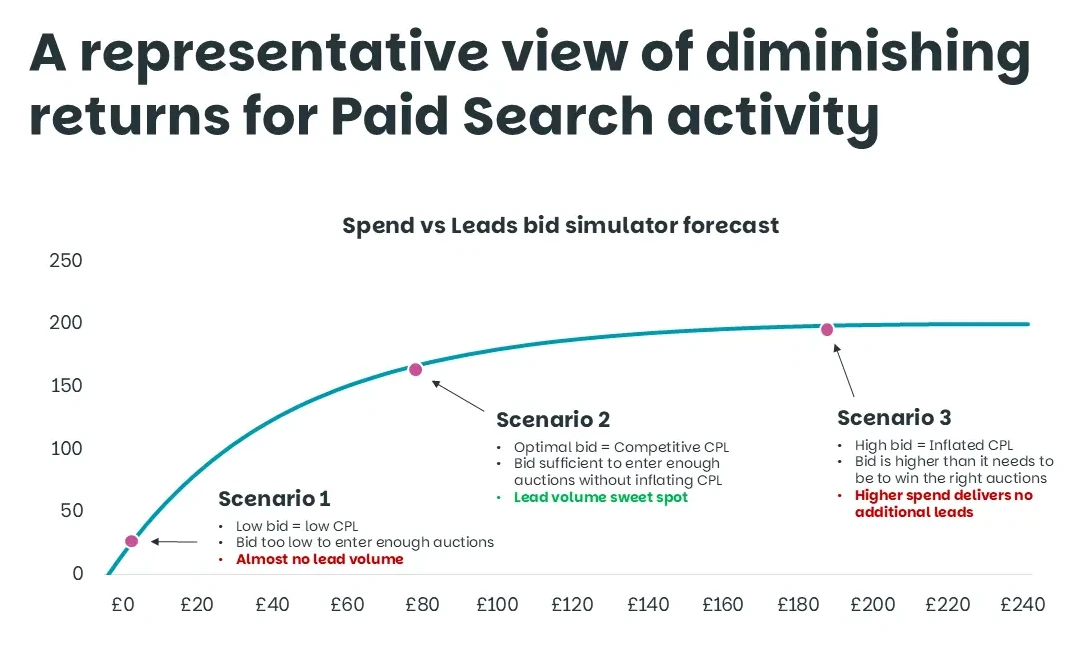
This chart illustrates a scenario for a brand with a high CPL model
International markets add complexity
For international advertisers, the same CPA or ROAS doesn’t necessarily represent the same commercial outcome in every market. A £50 acquisition might be perfectly acceptable in one country and unattractive in another, depending on margins, average order value, customer lifetime value, conversion rates and the likelihood that a lead will become a customer.
Applying the same Target ROAS across several markets may make an account easier to manage, but it can conceal important differences. One market might have higher-value customers; another might have cheaper media but lower customer lifetime value. The same applies to lead generation: a £50 lead can be worth considerably more in a market with a higher lead-to-sale conversion rate.
As Jules explains: “I’d be wary of treating a lower CPA as proof that one market is performing better than another. Sometimes it simply means we’ve found a market where Google can buy conversions cheaply. That isn’t the same thing as creating more value for the business.”
Google is extremely good at interpreting performance data but can’t necessarily tell you whether the commercial assumptions behind that data are still valid.
A higher CPA isn’t necessarily a worse result
There is a danger that advertisers will see campaigns moving closer to their stated targets and conclude that performance has deteriorated. But if a campaign has been achieving a £30 CPA against a £50 target and moves towards £50, it may simply be doing a better job of following the instruction it has been given.
The useful question is what that extra cost buys. Paying £45 rather than £30 for a customer could be an excellent trade if it generates substantially more profitable volume. For another business, protecting the £30 CPA might matter much more. The algorithm cannot make that judgement; it can only optimise towards the objective it is given.
It may be time to look at some very old targets
Google hasn’t automatically changed advertisers’ targets. The change is in how the system responds to the target already in place, making this a useful prompt to review campaigns that have consistently outperformed their targets.
Google has introduced a Bid Target Adjustment Tool to help advertisers review affected campaigns and make recommendations based on recent performance. It should be useful, but it doesn’t replace the more important question of whether the target still reflects what the business wants the campaign to achieve. For international accounts, that assessment needs to happen at market level.
The market can explain what the account can’t
Suppose one country is generating leads at £35 and another at £60. It would be tempting to conclude that the second market needs to improve.
But perhaps those £60 leads are considerably more likely to become customers. Perhaps the average customer is worth twice as much. Perhaps £60 is actually an excellent result given the competitive environment.
The reverse can also be true. An exceptionally low CPA isn’t necessarily something to protect if profitable demand exists at a higher cost. An unusually low target could potentially constrain growth.
This is where local market expertise becomes particularly useful. At Oban, our Local In-Market Experts help us understand whether differences between markets reflect genuine variations in competition, customer behaviour and commercial economics rather than simply assuming that one number is better than another.
The more automation improves, the more the objective matters
There is a broader shift here beyond this particular Google update. As automated bidding improves, advertisers are handing more tactical decision-making to the platforms. That is generally a good thing: Google can process vastly more signals and make vastly more individual bid decisions than a human account manager ever could.
The opportunity is to reinvest the time saved on those tactical decisions in more strategic digital marketing. What constitutes a valuable conversion? How much is a new customer really worth? Is revenue the right measure, or should the business ultimately be optimising towards margin or customer lifetime value? Answering those questions through deeper analysis becomes increasingly important as the platforms take on more of the tactical work.
The better the automation gets at executing an objective, the less room there is for a poorly defined one – which makes human judgement and strategic thinking more important, not less.
What we’re seeing so far
Our early experience across the Oban portfolio has been encouraging. Performance has remained broadly stable, with some CPA improvement for one client, although we are continuing to monitor the results as the change beds in.
For now, we don’t think the right response is to start changing targets across the board. Instead, advertisers should identify affected campaigns, particularly those that have historically outperformed their stated targets, and ask whether the number in the account still reflects the commercial objective. A useful review might ask:
- Is this target a genuine commercial objective, or simply an inherited setting?
- Would we be prepared to pay more for additional profitable volume?
- Does the target reflect the economics of this particular market?
- Are we measuring value in the right way, particularly for lead generation?
- If the target is changed, what commercial outcome are we hoping to produce?
If you’d like to discuss what this means for your business, please get in touch.
Let’s accelerate action together
At Oban, we believe change happens when we act, support each other, and keep moving forward. These stories show how small steps can make a big difference. If you want to improve your digital marketing, get in touch. Let’s get started.